What Hidden Costs Show Up in Crawlspace Remediation Estimates?

November 1, 2026

Introduction

A crawlspace remediation estimate looks straightforward on paper: a price for encapsulation, maybe a dehumidifier, done. Then the crew gets underneath the house, and the number changes.


This is one of the more common surprises homeowners in Charlotte, NC run into, not because contractors are padding bills, but because crawlspaces routinely hide problems that can't be seen or priced accurately until someone is physically underneath the home.


The initial estimate is often based on a visual walk-through rather than a full excavation of every corner. That's a reasonable starting point, but it also means the final invoice can look different once insulation is pulled back or old ductwork turns out to be damaged.


This isn't a sign of dishonest pricing. Crawlspaces routinely conceal decades of small issues that were never visible from the entry point, and a thorough contractor will flag these possibilities before starting, even if the exact scope can't be finalized until the crew is underneath the home.

Homeowners across Charlotte, NC who understand these categories ahead of time are far less likely to feel blindsided when a final invoice looks different from the initial walk-through estimate.


Moisture and Mold Related Add-Ons

Moisture is the primary reason homeowners pursue crawlspace remediation in the first place, but the extent of that damage often isn't clear until the vapor barrier or old insulation is removed.

  • Visible mold growth on floor joists or subfloor, which requires treatment before encapsulation can proceed.
  • Standing water or saturated soil, which may require a sump pump or additional drainage first.
  • Water-damaged or sagging insulation, which needs to be removed and replaced rather than covered over.
  • Musty odors traced to hidden leaks, sometimes requiring plumbing repair before remediation is complete.


Structural Repairs Uncovered Mid-Project

It's common for a crawlspace crew to find several kinds of damage once they get a clear, unobstructed view of the space, and each one typically falls outside the original encapsulation scope.

  • Rotted or sagging floor joists that need sistering or replacement.
  • Undersized or failing support posts that no longer carry the load properly.
  • Termite or wood-destroying insect damage in framing members.

In Charlotte, NC specifically, older homes with original crawlspace framing are more likely to reveal these surprises, simply because decades of humidity exposure without a vapor barrier gives rot and pests more opportunity to take hold.


Permit, Access, and Disposal Fees

Beyond materials and labor directly tied to remediation, several administrative and logistical costs can catch homeowners off guard.

  • Local permitting requirements tied to the scope of work.
  • Disposal fees for old insulation, debris, or contaminated materials.
  • Added labor for crawlspaces with very limited clearance.
  • Equipment access charges on properties with restricted driveways or narrow lots.

Access difficulty in particular is easy to underestimate from a walk-through alone, since a crawlspace with very low clearance requires crews to work in a confined space for hours at a time, which slows progress considerably.


Ongoing Maintenance Costs After Encapsulation

Encapsulation isn't a one-time expense that ends the moment the crew leaves. A few components need periodic attention to keep the system performing as intended.

  • Dehumidifier filter changes and occasional service.
  • Sump pump testing to confirm it activates properly.
  • Periodic inspection of the vapor barrier for tears or settling.

Warranty coverage varies significantly between contractors here as well. An installation backed by a comprehensive, transferable warranty may cost more upfront but save considerably on maintenance and replacement costs down the road.

Homeowners in Charlotte, NC planning a remediation project should ask specifically what the warranty covers and for how long, since this detail affects the true long-term cost of the system far more than the initial installation price alone.


Questions to Ask Before Signing a Remediation Contract

A short list of upfront questions can prevent most of the surprises described above.

  • How does the company handle findings discovered once work begins?
  • Are change orders approved by the homeowner before additional work starts?
  • What specifically is covered under the warranty, and for how long?
  • Are permit and disposal fees included in the quoted price?


Frequently Asked Questions

  • Is crawlspace remediation ever covered by homeowners insurance?

    It depends on the cause. Damage from a sudden covered event, like a burst pipe, may be covered, while gradual moisture issues from normal humidity or grading problems typically are not.

  • How long does a crawlspace encapsulation system typically last?

    A properly installed vapor barrier and dehumidification system can last fifteen to twenty years or more, though components like sump pumps and dehumidifiers may need replacement sooner.

  • Does crawlspace remediation include pest control?

    Not usually as a standard part of encapsulation, though sealing the space does reduce entry points for pests, and some contractors offer pest treatment as an add-on service.

  • Can I do a partial encapsulation to reduce upfront cost?

    It's possible to phase the work, such as addressing the wettest areas first, but partial encapsulation generally provides less protection and may need to be completed fully later to be fully effective.

  • How often should an encapsulated crawlspace be inspected after installation?

    An annual check is generally recommended, along with a look after any major storm, to confirm the vapor barrier is intact and the dehumidification system is functioning properly.

Conclusion

Crawlspace remediation estimates in Charlotte, NC often grow once a crew can see the full picture underneath a home, but knowing where hidden costs typically come from helps homeowners plan realistically instead of being blindsided.


Structural Works Group provides thorough crawlspace evaluations upfront so surprises are minimized before work begins. Call 980-522-7581 for a free evaluation of your crawlspace.
Foundation repair ad for a house, showing a “For Sale” sign, cracked wall, and estimate paperwork with calculator.
October 25, 2026
A properly repaired foundation can protect and even boost resale value in Charlotte, NC — here's how buyers and appraisers actually view the work.
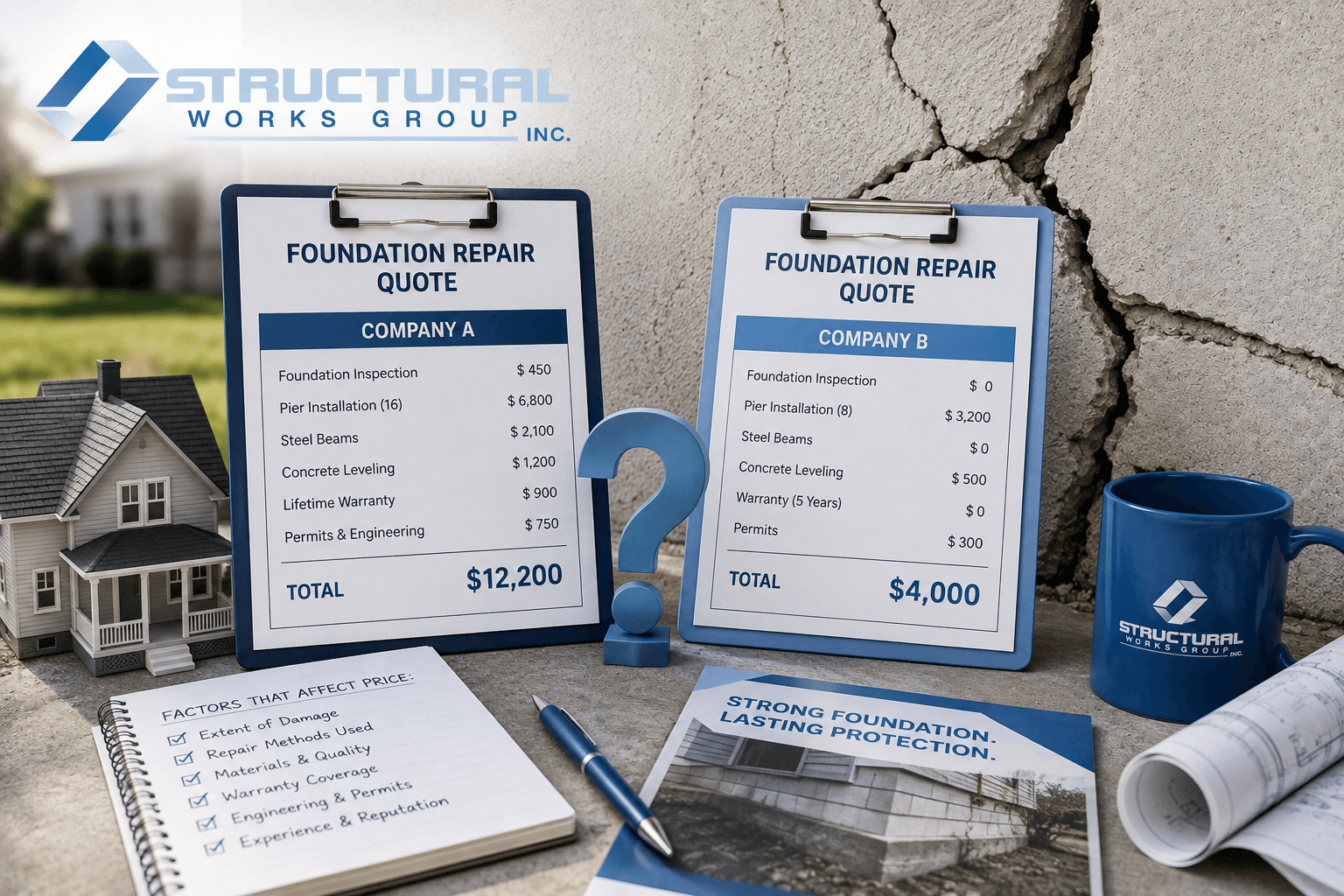
Foundation repair quote boards, house photo, pen, mug, and rolled plans on a desk with a cracked wall backdrop
October 4, 2026
Two foundation repair quotes for the same Charlotte, NC home can differ by thousands — here's what actually causes the gap.
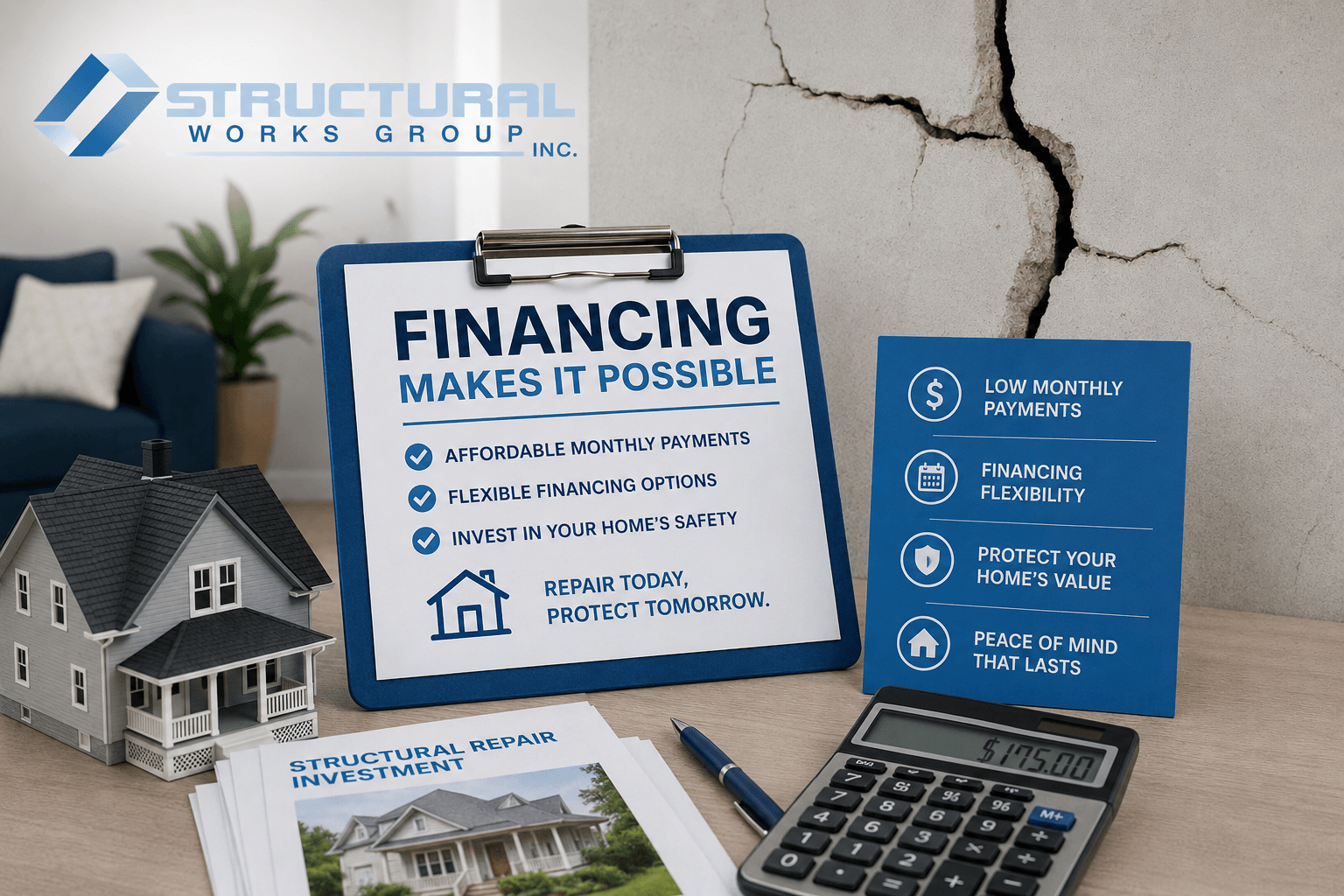
Financing flyer beside house model, calculator, and blue brochure on a desk with Structural Works Group logo
September 27, 2026
Financing won't lower the total cost of structural repair, but it can make an urgent Charlotte, NC repair far more manageable to pay for.
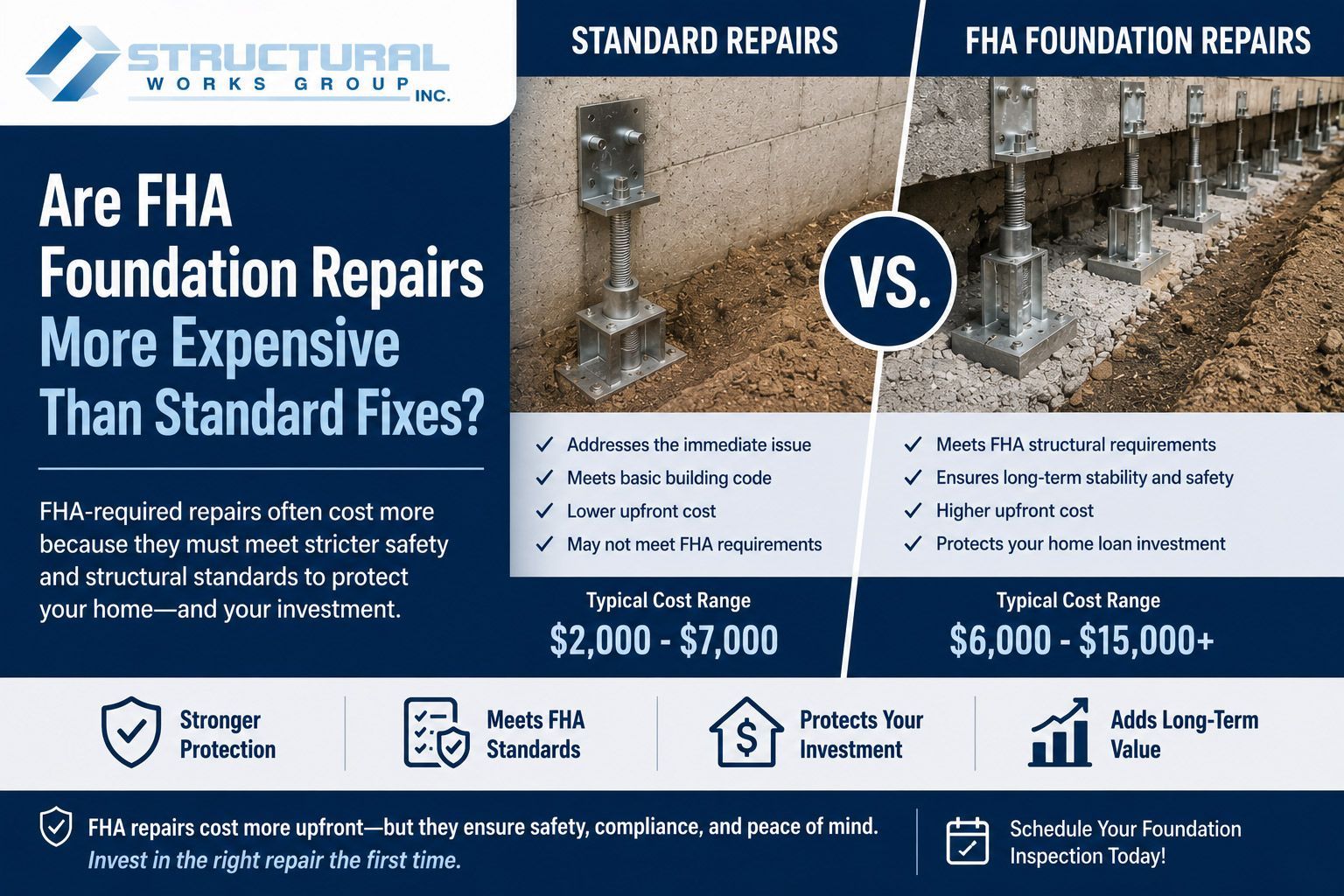
FHA foundation repair comparison infographic with cracked floor, standard vs FHA repairs, costs and features
September 6, 2026
Delaying foundation repair in Charlotte, NC almost always costs more than fixing it early — here's how the expense compounds over time.
Infographic comparing standard and FHA foundation repairs, showing cracks, prices, and cost differences.
August 30, 2026
FHA foundation repairs aren't always more costly — learn when they are, why, and how to navigate government-backed repair requirements.
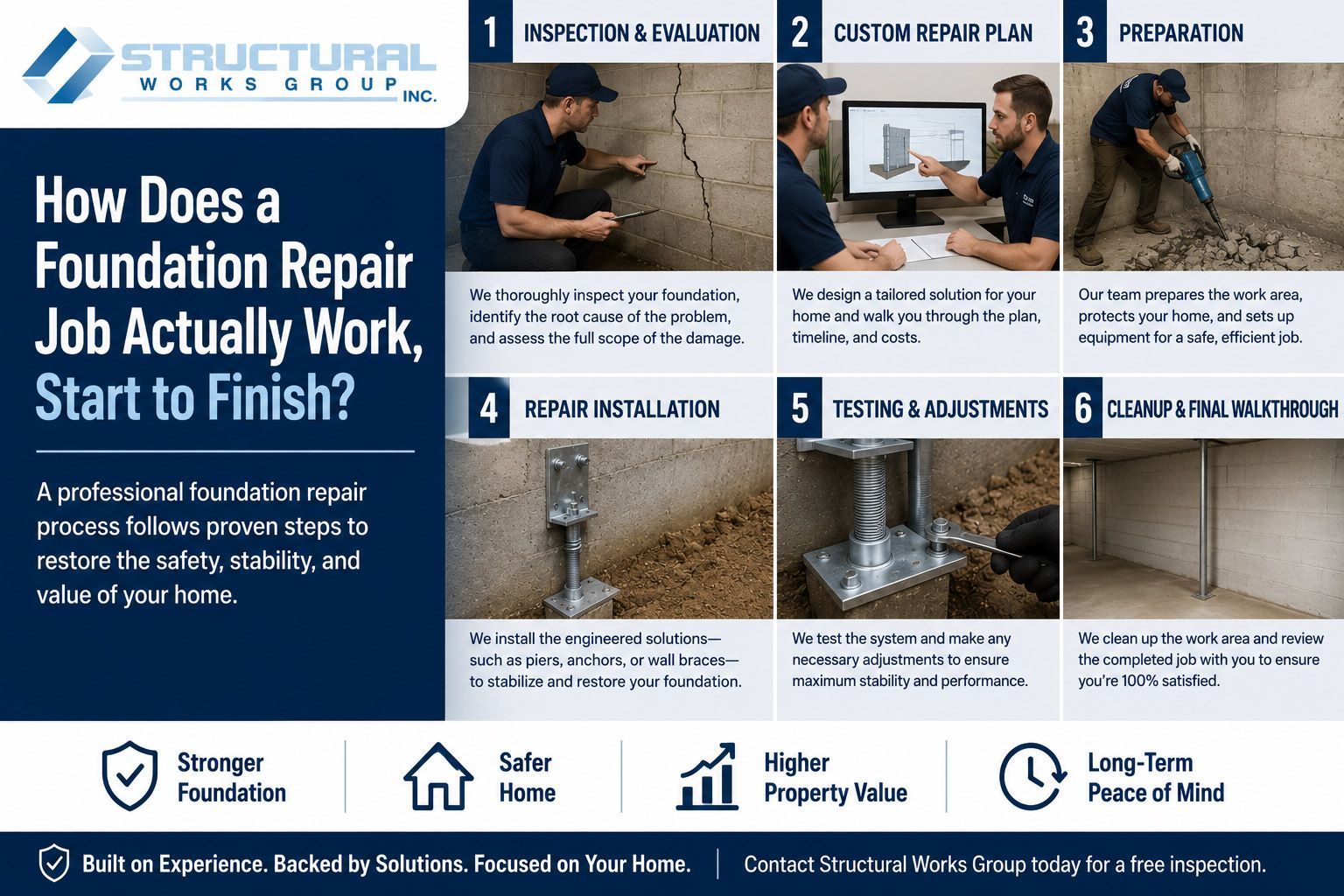
Infographic on foundation repair workflow, with six step photos and blue construction-themed design
August 2, 2026
From inspection to final walkthrough, here is exactly how a professional foundation repair project works so you know what to expect.
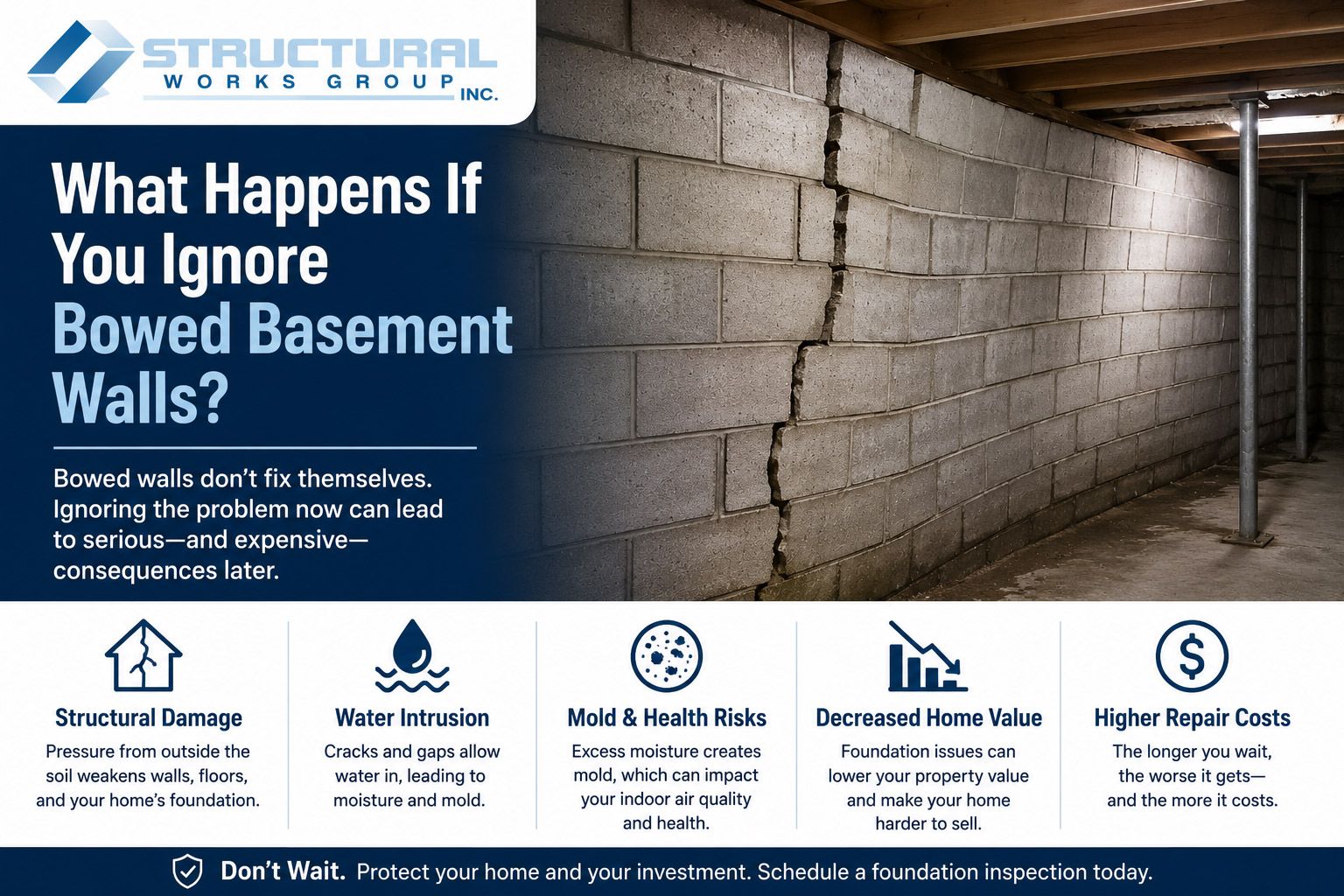
Infographic about the risks of ignoring bowed basement walls, with brick wall graphic and blue/white layout
July 26, 2026
Ignoring bowed basement walls leads to water damage, floor failure, and costly reconstruction — here is the full progression of damage.
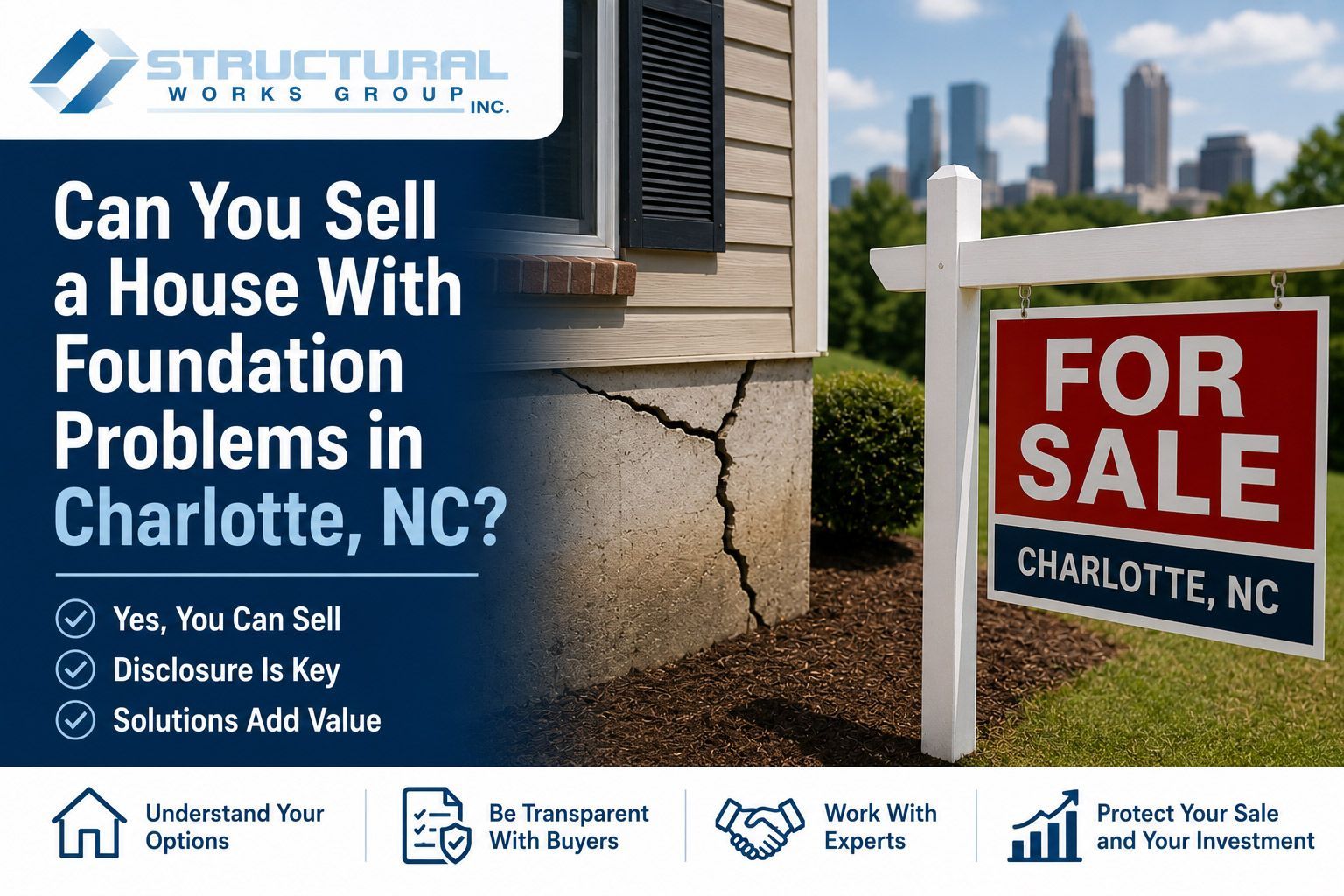
Graphic: “Can You Sell a House With Foundation Problems in Charlotte, NC?” with for-sale sign and house foundation crack
July 5, 2026
You can sell a Charlotte home with foundation problems — disclosure is required and repair often pays off. Here's what you need to know.
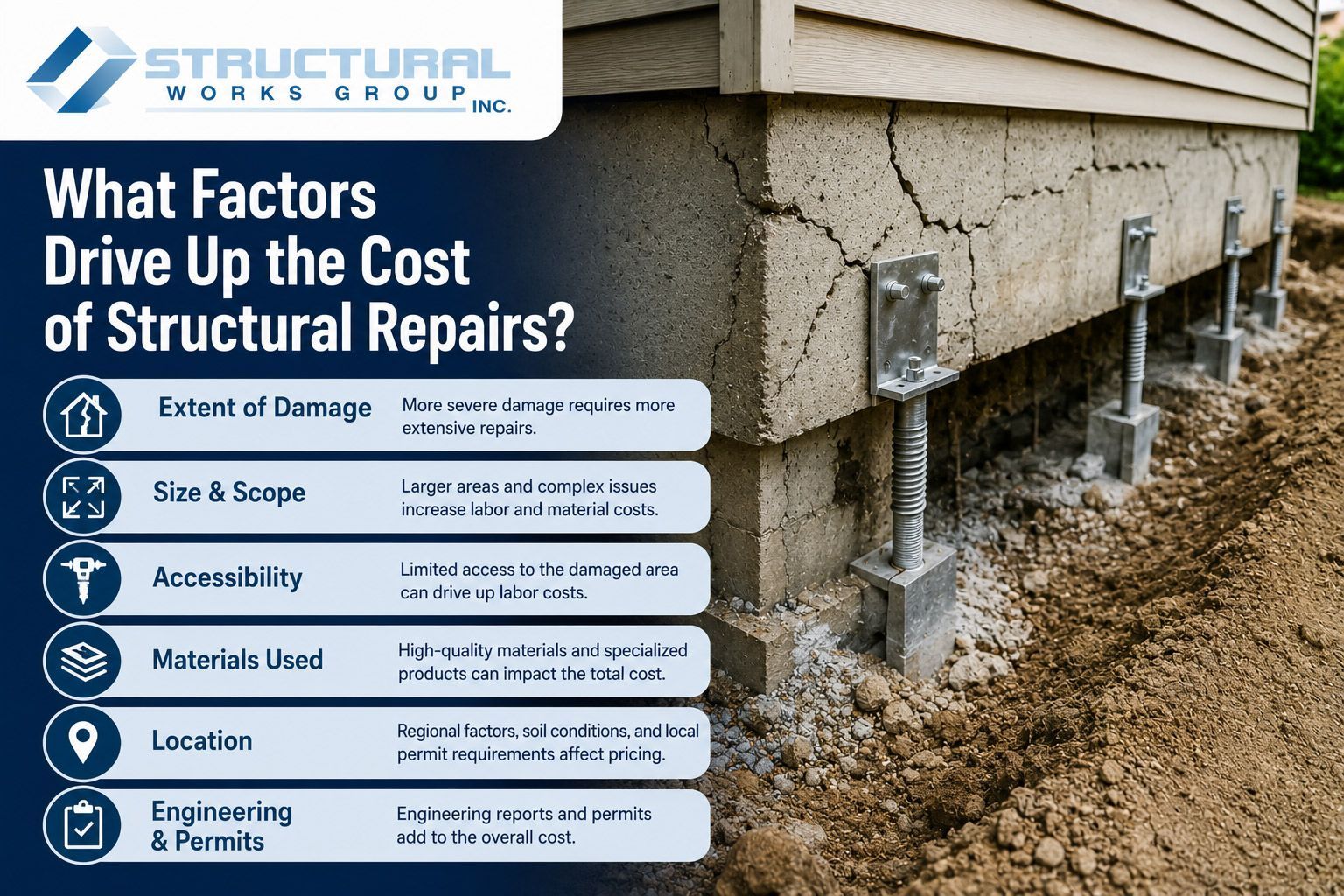
Infographic on structural repair costs beside a cracked home foundation with drainage damage beneath siding
June 28, 2026
Structural repair is one of those categories where two homeowners with seemingly similar problems can receive quotes that are thousands of dollars apart. That gap is not random — it is the product of specific variables that experienced contractors assess before they can give you an accurate number. If you have recently received a structural repair estimate that was higher than you expected, or if you are trying to budget for work you know is coming, understanding what actually drives cost is the most useful place to start. Some of these factors are outside your control, but others can be managed with the right timing and approach. The Severity and Extent of Existing Damage The single biggest cost driver in any structural repair project is how far the damage has progressed. A hairline crack in a foundation wall that is monitored and addressed early is a fundamentally different — and far less expensive — repair than a crack that has widened over years, allowed water infiltration, and triggered wood rot in adjacent framing. Every month that structural damage goes unaddressed, the scope of repair typically expands. In Charlotte, NC, the region's clay-heavy soils and high seasonal humidity accelerate this progression. What begins as a minor settling issue can develop into bowed walls, cracked slabs, and compromised joists if left alone. Early intervention is almost always the single most effective way to keep structural repair costs manageable. Accessibility and Site Conditions Labor costs are directly tied to how easy or difficult it is for crews to access the damaged area. Several site conditions add meaningful cost to structural repair projects: Crawlspace clearance — very low crawlspaces require workers to maneuver in confined quarters, slowing work and increasing labor hours Landscaping or hardscaping — exterior foundation repair that requires removing and replacing mature landscaping, patios, driveways, or retaining walls adds significant material and labor cost Slope and grade — homes built on sloped lots in Charlotte, NC and the surrounding hill country often have uneven foundation depths, making excavation more complex Finished basements — repairs in finished basements require either working around existing finishes or removing and replacing flooring, drywall, and trim Equipment access — properties on narrow lots or with restricted driveway access may prevent heavy equipment from reaching the work area, requiring alternative methods These conditions are not factors a contractor inflates arbitrarily — they represent genuine increases in labor time and complexity that translate directly into higher project costs. The Type of Repair Method Required Different structural problems call for different repair approaches, and those approaches carry very different price tags. The method selected is determined by the type of damage, not by cost preference. Here is how common repair methods compare in terms of typical cost ranges: Carbon fiber strap installation for bowing walls: $300 – $600 per strap, with most walls requiring multiple straps Wall anchor systems for moderate to severe bowing: $500 – $1,200 per anchor Helical or push pier installation for settling foundations: $1,000 – $2,500 per pier, with most projects requiring multiple piers Full crawlspace encapsulation: $5,000 – $12,000+ depending on size and condition Concrete slab lifting with polyurethane foam: $800 – $2,500 depending on the area Full basement wall excavation and waterproofing: $10,000 – $25,000+ In Charlotte, NC, piering is particularly common due to expansive clay soils that cause foundation settling. Projects requiring multiple piers — often six to twelve for a single corner of a home — accumulate costs quickly but deliver lasting stability when properly installed. Underlying Causes That Must Be Addressed One of the most overlooked cost components in structural repair is the work required to address the root cause of the damage. Repairing a foundation wall without fixing the drainage issue driving hydrostatic pressure against it is like patching a ceiling without fixing the roof leak above it — the repair will not hold. Root cause correction often adds to the project cost but is essential for the repair to be effective and lasting. Common root cause corrections include: Exterior waterproofing and drainage system installation Downspout extension and grading corrections to redirect surface water away from the foundation Interior drain tile system installation to manage groundwater Sump pump installation or replacement Soil stabilization or compaction in areas of significant settlement Homeowners in Charlotte, NC who address only the structural symptom and not the underlying water or soil problem should expect the damage to recur, often within a few years. Getting the root cause corrected as part of the initial project is almost always more cost-effective than returning for repeat repairs. Frequently Asked Questions
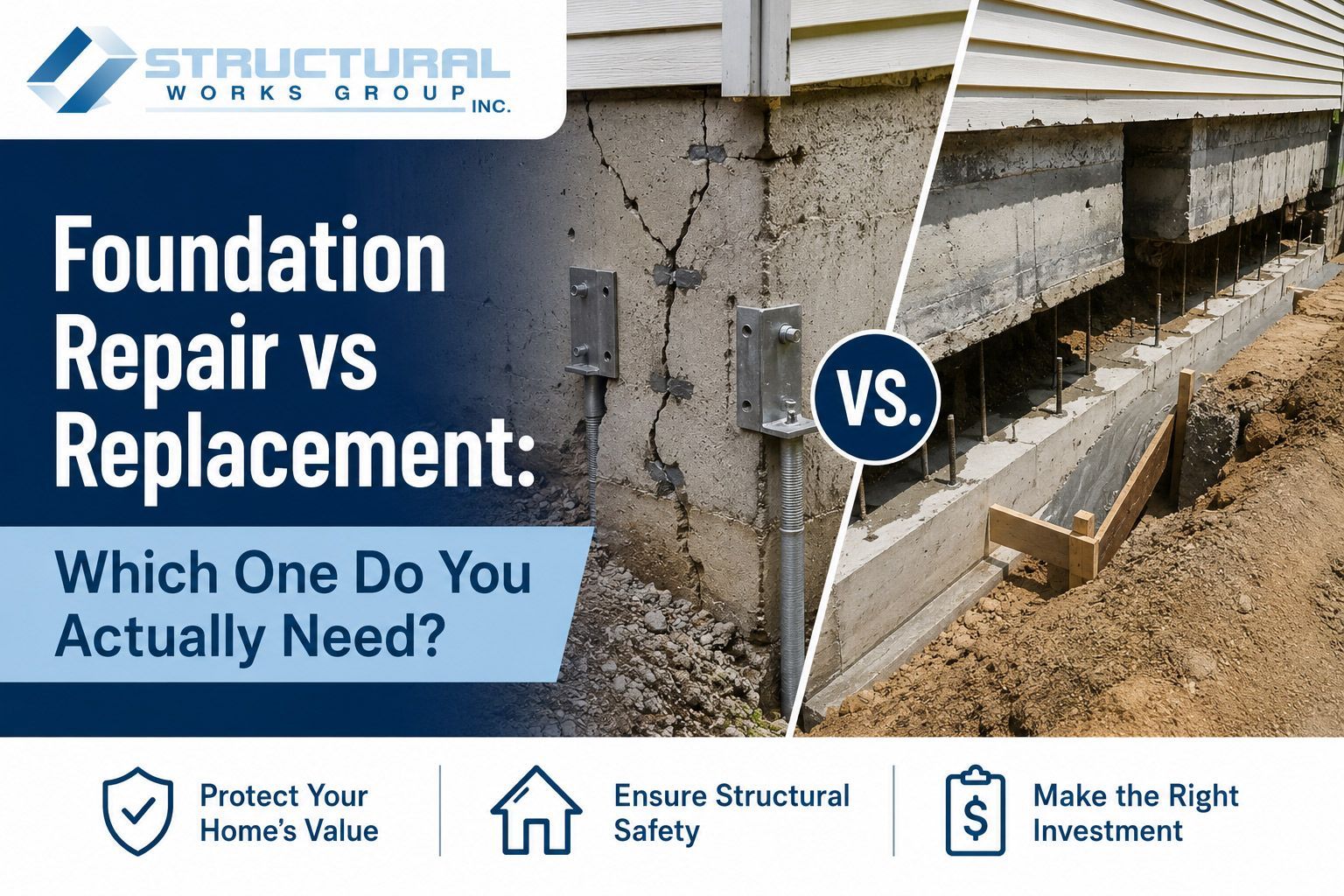
Graphic comparing foundation repair vs replacement with split-house image and “Which one do you actually need?” text
May 31, 2026
Most foundation damage can be repaired, not replaced — learn what factors determine the right approach for your home.