What Happens If You Ignore Bowed Basement Walls?
July 26, 2026
A bowed basement wall is rarely an emergency the day you first notice it. The inward curve might be subtle — a few inches at most — and the wall might look basically intact except for some horizontal cracking along the blocks. This is precisely why so many homeowners decide to wait and watch before doing anything. It does not look catastrophic. But bowing walls are one of the most deceptive structural problems a home can have, because the forces causing the bowing do not stop when you stop paying attention to them. What looks manageable today follows a predictable, damaging progression if left unaddressed. Here is exactly what that progression looks like.
Why Basement Walls Bow in the First Place
Understanding the cause of bowing walls is important because it explains why the problem gets worse over time rather than stabilizing on its own. Most basement wall bowing is caused by lateral soil pressure — the weight and movement of the soil pressing against the exterior face of the wall. In Charlotte, NC and throughout the Carolinas, this pressure is amplified significantly by the region's high clay content in the soil. Clay absorbs water during wet seasons and expands, pressing harder against foundation walls. During dry periods, clay contracts, which can pull the wall and cause cracking. This cycle of expansion and contraction, repeated year after year, progressively weakens the mortar joints in block walls and the concrete in poured walls. Every wet season, the wall gets pushed a little further inward than it was pushed the year before.
Stage One: Minor Bowing and Horizontal Cracking
In the early stages, a bowing basement wall typically shows one or more horizontal cracks running through the middle third of the wall, where lateral soil pressure is greatest. The wall may have moved inward by one to two inches. At this stage, repair options are least invasive and least expensive. Carbon fiber straps or wall anchors can stabilize the wall effectively, preventing further movement. The wall is not in danger of collapse, and no other structural systems in the home are typically affected yet. Unfortunately, this is also the stage where most homeowners decide the problem is not urgent enough to address — a decision that sets the progression in motion.
Stage Two: Progressive Movement and Secondary Damage
Left unrepaired, bowing walls in Charlotte, NC homes do not stay at Stage One. As lateral pressure continues through seasonal cycles, the wall moves further inward — typically reaching two to four inches of deflection or more. Several secondary problems begin to develop at this stage:
- Crack widths increase, allowing water infiltration that saturates the block cores or migrates into the basement floor area
- Moisture intrusion leads to mold growth on the wall surface and adjacent wood framing
- Floor joists resting on top of the compromised wall begin to lose reliable support as the wall shifts
- The gap between the wall and the floor slab may open, allowing soil, insects, and water to enter directly
- In block walls, individual blocks may begin to shift or tip outward at the top of the bow
Repair at this stage is more involved than at Stage One. Wall anchors must be used rather than carbon fiber straps, and if water damage has affected the framing above, that must be addressed simultaneously. Cost at Stage Two is typically two to four times higher than repair at Stage One.
Stage Three: Structural Failure and System-Wide Consequences
If a bowing wall in Charlotte, NC reaches four to six inches of inward deflection without intervention, the risk of sudden partial or total wall collapse becomes significant. At this stage, the consequences extend far beyond the basement wall itself:
- Floor systems above the wall begin to sag as support is compromised, creating visible slopes and soft spots in first-floor living areas
- Door and window frames on the floors above begin to rack, making them difficult or impossible to open and close
- The foundation's ability to bear and transfer structural loads is compromised, affecting the integrity of the walls and roof above
- In worst-case scenarios, a sudden wall failure during or after a heavy rain event can cause rapid collapse of the adjacent floor system
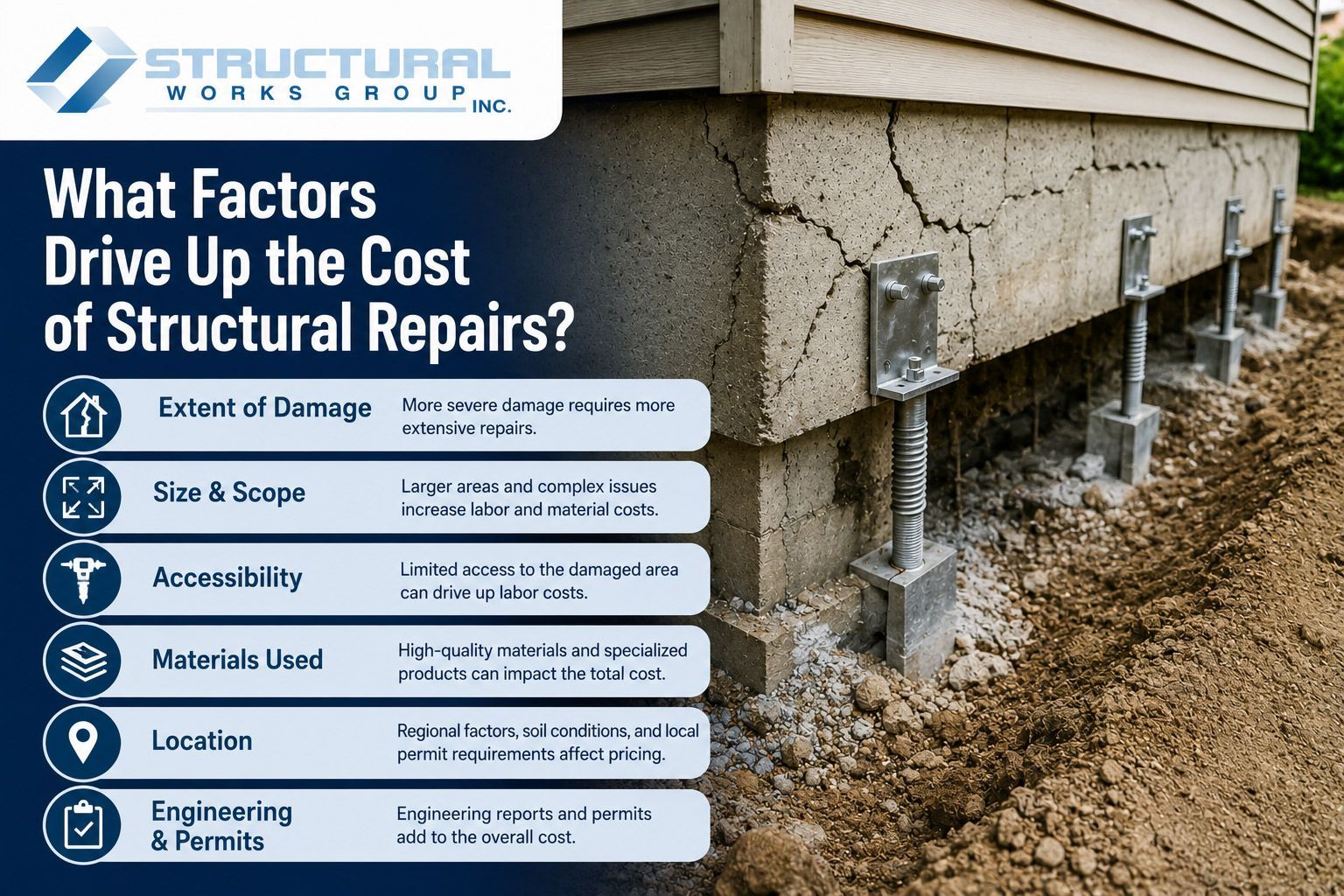
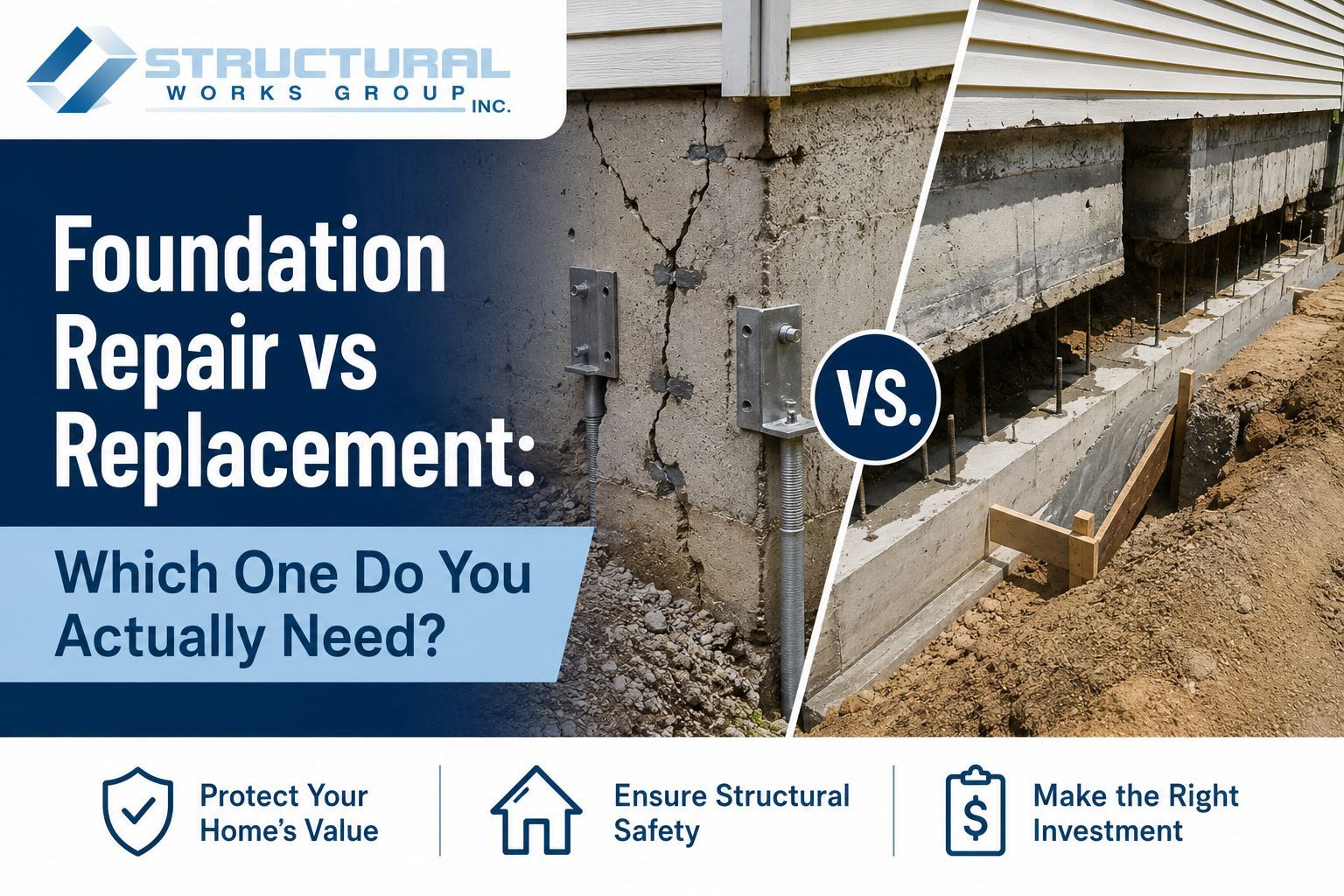
Repair at this stage frequently involves excavation of the exterior soil, wall replacement or reconstruction, waterproofing, and repair of the framing systems above. Total project costs can be five to ten times higher than the original repair would have cost at Stage One. In some cases, the extent of damage makes repair so expensive that it approaches or exceeds the cost of significant structural reconstruction.
Frequently Asked Questions
How fast do bowed basement walls typically progress?
The rate of progression depends on soil type, drainage conditions, and how wet the seasonal cycles are. In Charlotte, NC and the Carolinas, where clay soils and high humidity accelerate the problem, walls that show minor bowing can progress to moderate deflection within two to five years if unaddressed. Walls that are already at moderate deflection can reach dangerous levels more quickly because the structural integrity is already diminished.
Can a bowed wall ever stabilize on its own without repair?
No. The soil pressure driving the bowing does not go away, and the seasonal moisture cycles that accelerate it are a permanent feature of the climate. A bowed wall may appear to stop moving for a period — often during dry seasons — but it will resume movement when moisture returns. There is no mechanism by which a bowed wall self-corrects without intervention.
Is a bowed wall dangerous to occupy the basement?
At minor to moderate deflection, routine basement use is generally not immediately dangerous. However, storing heavy items against a bowing wall, or using the basement during or immediately after very heavy rainfall, increases risk. At significant deflection — generally considered four inches or more — professional evaluation should be obtained immediately and the area near the wall should not be used until it is assessed and stabilized.
Does homeowners insurance cover bowed wall repair?
Generally no. Bowing walls caused by lateral soil pressure are classified as gradual structural damage, which is excluded from standard homeowners policies. Coverage may exist if the wall failure is triggered by a sudden covered event, but soil pressure and seasonal clay movement — the primary causes — are not covered perils. This is another reason early repair is financially important: the costs are entirely out-of-pocket, and they grow as the problem advances.
What is the difference between a bowed wall and a cracked wall — are they equally serious?
Not necessarily. Cracks alone may be cosmetic or structural depending on their orientation, width, and whether they show differential movement. Horizontal cracks associated with bowing are typically more serious than vertical or diagonal shrinkage cracks in new concrete because they indicate active lateral force. A bowed wall with horizontal cracking is almost always a structural concern that requires professional assessment, while some isolated vertical cracks in poured concrete may be monitored rather than immediately repaired.
Conclusion
Bowed basement walls follow a well-documented progression from a manageable repair to a serious structural problem — and the cost and complexity of repair grows at every stage. The homeowners who fare best are those who address bowing early, before secondary water damage, framing issues, and advanced deflection turn a straightforward fix into a major reconstruction project. If you have noticed cracking or bowing in your basement walls, Structural Works Group serves Charlotte, NC and the surrounding region with professional wall stabilization, waterproofing, and structural repair services. Call us at
980-522-7581 to schedule a free evaluation before the problem advances to the next stage.